


Climate change is often framed as an environmental issue. In reality, it is increasingly becoming an economic force—one that affects production, incomes, and even the stability of nations.
In both Armenia and Azerbaijan, this impact is most visible in agriculture. In both countries, the sector remains a primary source of employment in rural areas and plays a crucial role in food security.
But rising temperatures, water scarcity, and more frequent extreme weather events are already reshaping the rules of the game.
How Climate Change Is Affecting the Two Countries
In Armenia, climate change is not just projected—it is already observed. Between 1929 and 2016, the country’s average annual temperature rose by 1.23°C, while average annual precipitation declined by around 9% between 1935 and 2016.
Under high-emission scenarios, Armenia’s average annual temperature could increase by approximately 4.7°C by 2100 compared to the 1961–1990 baseline, while precipitation may decrease by about 8.3%.
In practical terms, this means a hotter—and in some regions, drier—climate. Agriculture is particularly vulnerable, as heat and drought simultaneously affect soil moisture, irrigation demand, and crop yields.
A similar trend is observed in Azerbaijan, though precipitation projections are more uncertain. Temperatures are expected to continue rising, with increases of 2–4°C by 2100 depending on the scenario.
By 2050, warming in western regions alone could reach 2.49°C, intensifying water scarcity. Both countries are clearly moving toward hotter climates.
Agriculture: Social Backbone, Economic Constraint
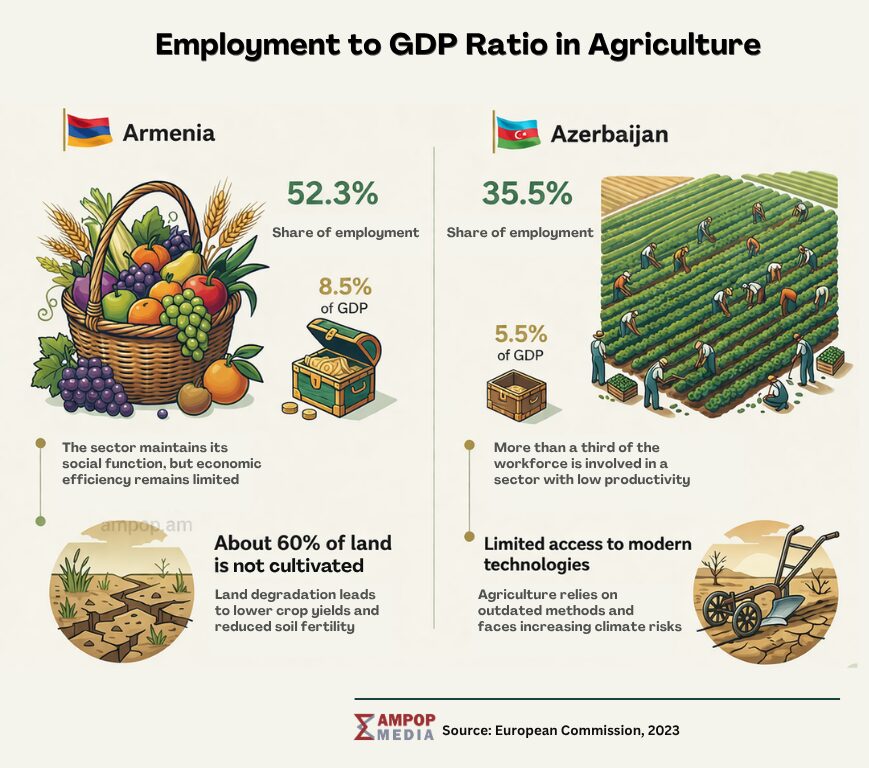
In Azerbaijan, agriculture employs more than one-third of the workforce but contributes relatively little to the economy. In 2023, it accounted for 35.5% of employment but only 5.5% of GDP.
This imbalance highlights agriculture’s social importance as a provider of jobs, while also revealing its low economic efficiency.
Armenia shows a similar pattern. In 2023, 52.3% of employment was in agriculture, while its contribution to GDP stood at just 8.5%.
According to Emil Gevorgyan, head of the JUSTUS Research and Consulting Foundation, the problem also lies in how governments conceptualize the sector.
He argues that agriculture should not be viewed merely as a source of income, but primarily as a foundation of food security.
“In this region, the state cannot fully rely on the idea that it will produce high-value goods and import essential food with the proceeds,” he says.
If agriculture is treated as a strategic sector, policy tools—from crop allocation to support for domestic production—would also change.
Azerbaijani economist Khalid Kerimli points to a similar issue. While around 40% of the workforce is employed in agriculture, its contribution to GDP remains low, indicating limited productivity.
“The issue is not just employment numbers,” he notes. “Agriculture remains a low-efficiency sector, reliant on outdated methods and increasingly exposed to climate risks.”
Production Without Self-Sufficiency
Azerbaijan’s agricultural output is concentrated in a few key crops. In 2023, the country produced around 3.2 million tons of grain, including 1.8 million tons of wheat.
It also produces significant volumes of potatoes, tomatoes, grapes, and cotton.
Despite this, the country remains dependent on imports. In 2023, Azerbaijan imported approximately $2.6 billion worth of agricultural products, with wheat accounting for about 11.8%.
This suggests that even with domestic production, the food system is not self-sufficient—an issue that could worsen under climate pressure.
Azerbaijan’s Deputy Minister of Agriculture, Ilhama Gadimova, has acknowledged that export growth alone is insufficient.
She emphasizes the need for structural reforms: infrastructure modernization, efficient land use, adoption of innovative technologies, and revised state support mechanisms.
In Armenia, the issue has its own nuances.
According to Emil Gevorgyan, Armenia has natural advantages—diverse soils and climate zones—but these often fail to translate into systematic results.
“The problem is not a lack of resources, but a fragmented approach to agriculture rather than a systemic one,” he explains.
Water: The Key Limiting Resource
Climate change affects agriculture primarily through water.
In Armenia, World Bank estimates from 2024 suggest that water losses in irrigation systems range between 20% and 67%.
Government data show that of the 3.3 billion cubic meters of water withdrawn annually, only 2.6 billion are actually used—meaning over 22% is lost before reaching end users.
At the same time, 86.2% of water consumption goes to agriculture, fisheries, and forestry, making these sectors particularly vulnerable.
In Azerbaijan, the situation is comparable.
Riad Akhundzade, a representative of the State Water Resources Agency, stated in February 2026 that reservoirs hold around 16–17 billion cubic meters of water, while annual consumption is 11–12 billion cubic meters.
“This means reserves are sufficient for roughly one year,” he warned, noting that infrastructure losses remain a major issue.
Environmental expert Rovshan Abbasov adds that more than 90% of food production in Azerbaijan depends on irrigation, while water losses exceed 50%.
Without transitioning to modern systems such as drip irrigation, demand will continue to grow while losses deepen.
Climate Change Already Affecting Yields
Climate change impacts not only water availability but also crop productivity.
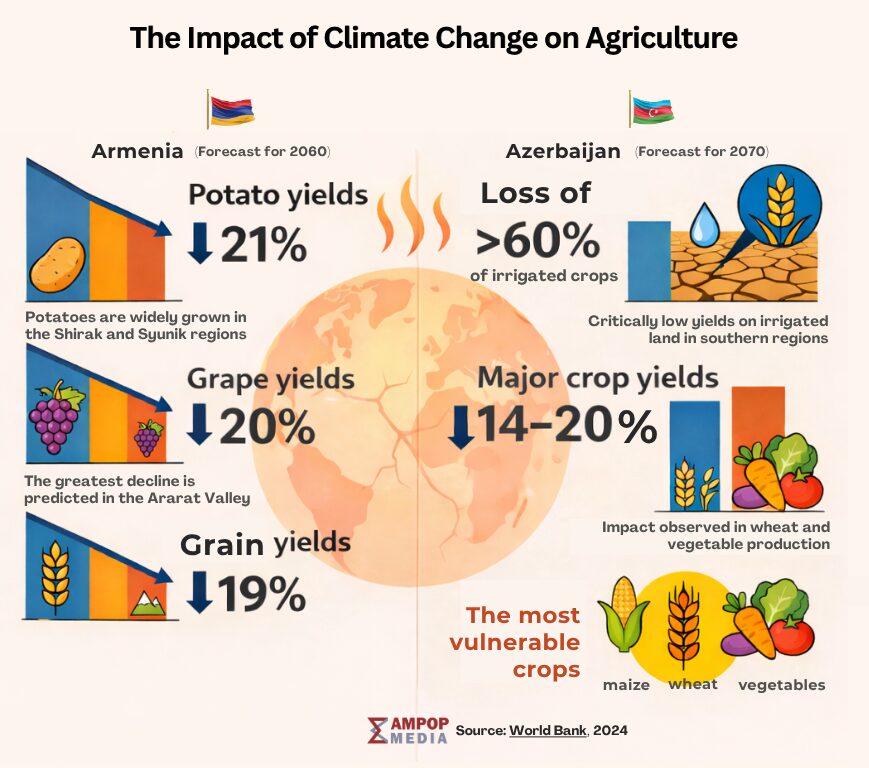
In Armenia, projections suggest declining yields for wheat, potatoes, and grapes by 2050.
In Azerbaijan, wheat, cotton, and several fruit crops are at risk.
These changes are driven not only by rising temperatures but also by unpredictable rainfall and more frequent droughts.
However, Gevorgyan cautions that yield declines are not always directly caused by climate change.
“Even in favorable years, losses can occur due to poor equipment, weak infrastructure, or lack of knowledge,” he notes.
In many cases, climate pressure simply accelerates existing systemic problems.
The Cost of Extreme Weather
Extreme weather events—droughts, hailstorms, and frost—are already causing significant economic damage.
In Armenia, losses in some years reach tens of billions of drams.
This increases risk, particularly for small farmers.
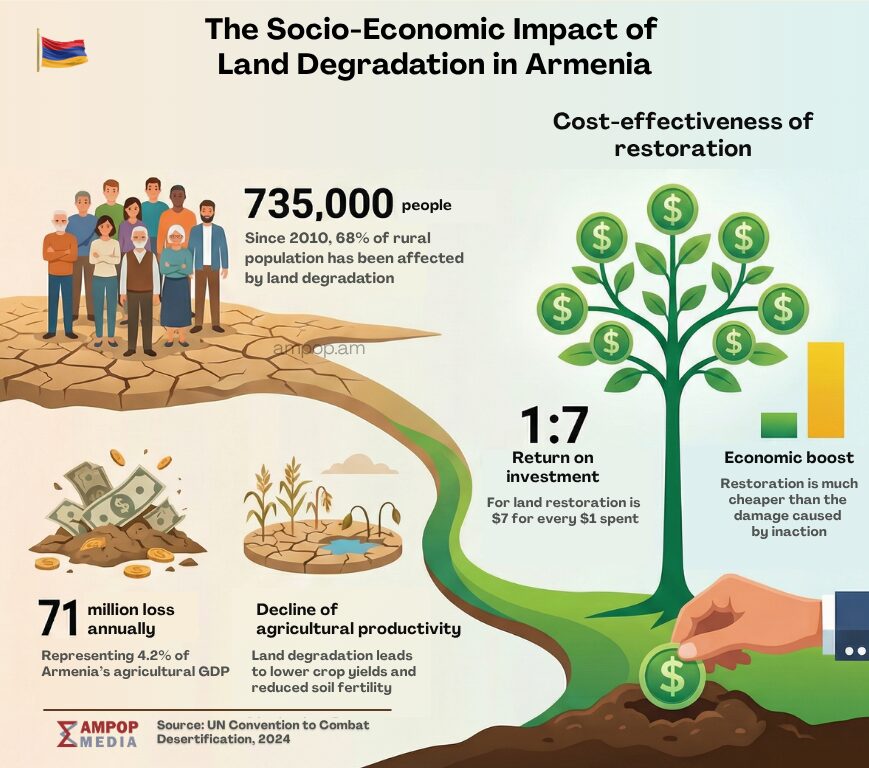
In response, Armenia’s 2025 “Water and Irrigation Services Improvement Program” aims to modernize infrastructure, improve water reliability, and strengthen climate adaptation capacity.
Yet major challenges remain: lack of safe drinking water in over 500 rural communities, high irrigation losses, pressure on the Ararat artesian basin, and weak monitoring systems.
Shared Challenges, Different Contexts
Despite structural differences, Armenia and Azerbaijan face similar challenges:
- limited water availability
- land degradation
- increasing climate risks
- low productivity
The approaches differ, but the core issue is the same: how to sustain agriculture under changing climate conditions.
From Resource Competition to “Climate Diplomacy”
If current trends continue, yields will decline, food dependence will grow, and rural incomes will fall.
But there is a critical factor: Armenia and Azerbaijan share similar climate zones and interconnected water systems.
Water—once a tool of conflict—could become a shared challenge under climate change.
“The future will depend not on having more resources, but on using existing ones more intelligently,” says Gevorgyan.
He argues that the region needs evidence-based policy—and even “climate diplomacy.”
“We need regional platforms and negotiations over water basin management. Unresolved issues could lead to new conflicts,” he warns.
At the same time, potential border openings could reshape agricultural markets.
Armenia, he says, must prepare scenarios now: what products it will bring to regional markets and how it will protect local producers.
“We have no alternative to opening borders. But it must be done wisely—with protection for local producers and a vision for sustainable development.”
By Suren Deheryan
This article was originally published on Media.am and is republished with permission.
Note: All materials published on Ampop.am and visuals carrying the Ampop Media branding may not be reproduced on other audiovisual platforms without prior agreement with Ampop Media and/or the executive team of Journalists for the Future.
Փորձագետի կարծիք
First Published: 12/04/2026