



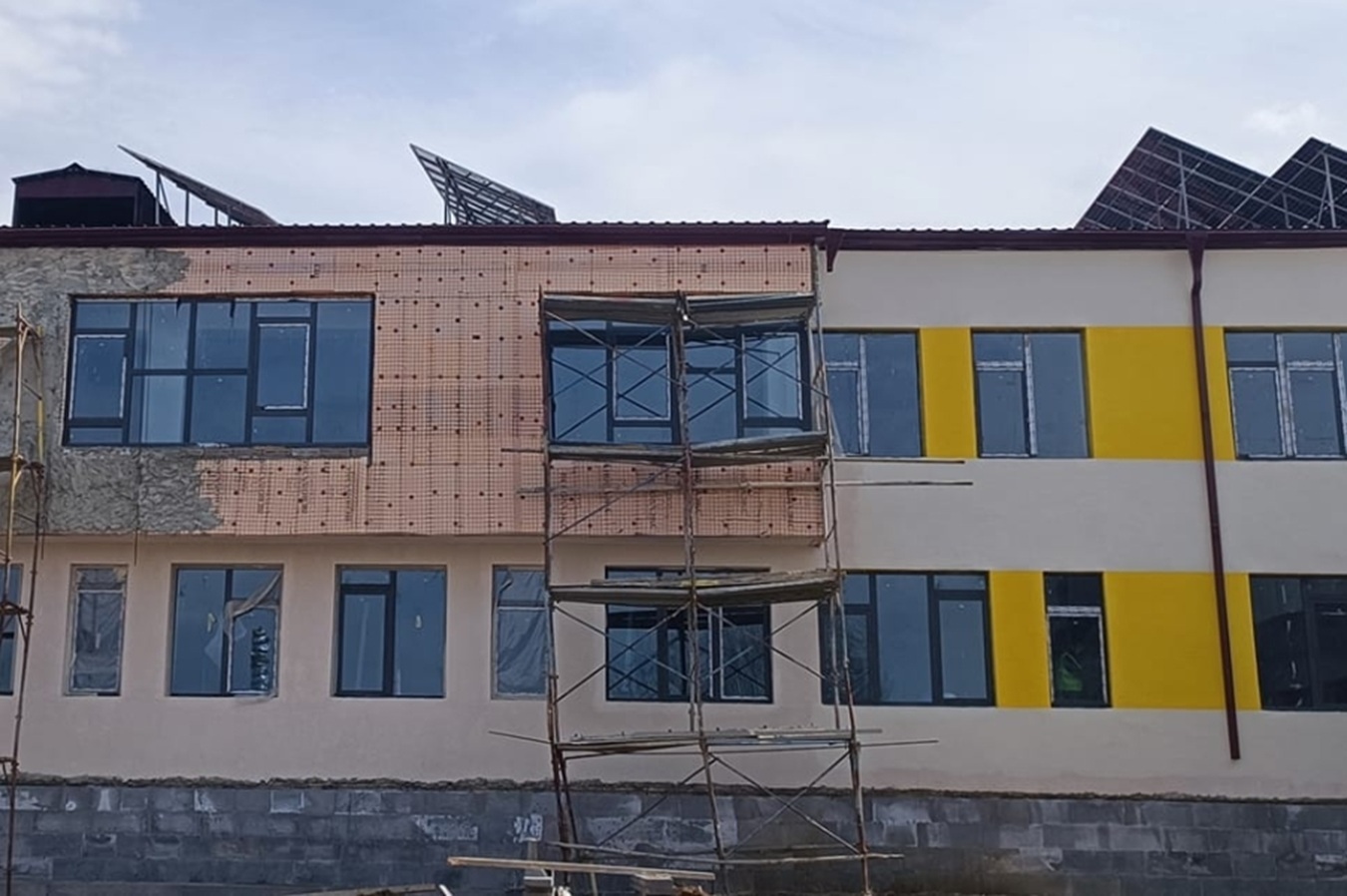
Armenia is embarking on one of the most consequential reforms of its education system since independence — a sweeping “school optimisation” programme aimed at improving quality and efficiency.
At its core, the policy seeks to consolidate hundreds of under-enrolled rural schools and relocate students to larger, better-equipped educational hubs in nearby communities.
But behind the promise of modernisation lies a far more complex and controversial question: can a country with fragile border regions afford to close its village schools?
Note: The original version of this article is in Armenian. The English text above presents an adapted version conveying the core findings and analysis for an international audience.
A System with Capacity – but Not Where It’s Needed
On paper, Armenia’s school infrastructure appears more than sufficient. The country’s 1,399 public schools are designed to accommodate over 661,000 students. In reality, only about 425,000 are enrolled.
That leaves more than 236,000 empty seats nationwide, with facilities operating at roughly 64% capacity.
Yet this underuse is unevenly distributed. In Yerevan, schools are often overcrowded, running double or even triple shifts. In contrast, rural regions carry the burden of emptiness: over 85% of unused capacity is concentrated outside the capital.
In provinces such as Gegharkunik, schools operate at just 42% of capacity, with similar figures across Aragatsotn, Syunik, Tavush and Vayots Dzor.
The pattern reflects a deeper structural issue: internal migration from villages to the capital, gradually hollowing out regional communities.
Crumbling Infrastructure, Mounting Costs
Beyond declining enrolment, Armenia’s school infrastructure is in poor condition.
Only 39.5% of schools are considered to have adequate facilities. The rest require either major reconstruction or at least partial renovation.
In regions such as Gegharkunik, Ararat and Aragatsotn, fewer than one in three schools meet acceptable standards.
Maintaining under-enrolled schools in deteriorating buildings presents a clear economic dilemma. For policymakers, consolidation becomes not just a reform — but a financial necessity.
Yet the geography of closures does not always align with infrastructure needs. Some regions with the most dilapidated schools see limited optimisation, while others with comparatively better conditions face widespread consolidation.
This suggests that cost-efficiency and student numbers — not infrastructure alone — are driving decisions.
The Economics of Small Schools: A System Under Strain
In 413 settlements, total student numbers fall below 100. In 162 of them, enrolment does not exceed 32 — too few to form even a single standard-sized class.
The imbalance becomes even more striking when looking at staffing.
In Syunik province, for example, 1,029 students are served by 1,091 staff members, including teachers and support personnel.
In other words, the workforce exceeds the number of students — a situation that policymakers argue is financially unsustainable.
From the government’s perspective, merging schools into larger, centralised institutions would allow for better teacher allocation, modern facilities and improved learning outcomes.
The Hidden Costs: Migration, Inequality and Security Risks
Critics argue that the reform risks triggering consequences far beyond the education system.
For many rural communities, especially in border areas, the school is more than an institution — it is a pillar of local life.
“If the school disappears, the village disappears,” is a common refrain among residents.
The logic is simple: without a local school, families are more likely to relocate to urban centres where education, jobs and services are accessible.
In border regions, this raises a sensitive issue — depopulation as a national security concern.
Distance and Access: Education Becomes a Journey
For many children, school consolidation will mean travelling 10–12 kilometres daily to neighbouring towns.
In mountainous terrain, particularly during winter, such journeys can be difficult and at times dangerous due to snow, ice and poor visibility.
This raises a fundamental concern: does optimisation improve quality at the cost of accessibility?
Conclusion
Armenia’s school optimisation programme highlights a dilemma faced by many small or centralised states: how to modernise public services without accelerating regional decline.
The success of the reform may ultimately depend not on cost savings or infrastructure upgrades alone, but on whether it can balance efficiency with equity — and education with survival.
By Suren Deheryan
All materials published on Ampop.am and visuals carrying the Ampop Media branding may not be reproduced on other audiovisual platforms without prior agreement with Ampop Media and/or the Journalists for the Future leadership.
Փորձագետի կարծիք
First Published: 05/04/2026