


Armenia’s food and energy security depends not only on domestic production, but also on foreign suppliers, global prices, logistics routes and regional political developments.
For a small, landlocked country with limited natural resources, that is hardly a new challenge. But wars, supply-chain disruptions, regional tensions and the growing politicization of trade have made one question increasingly urgent: how prepared is Armenia for an external shock?
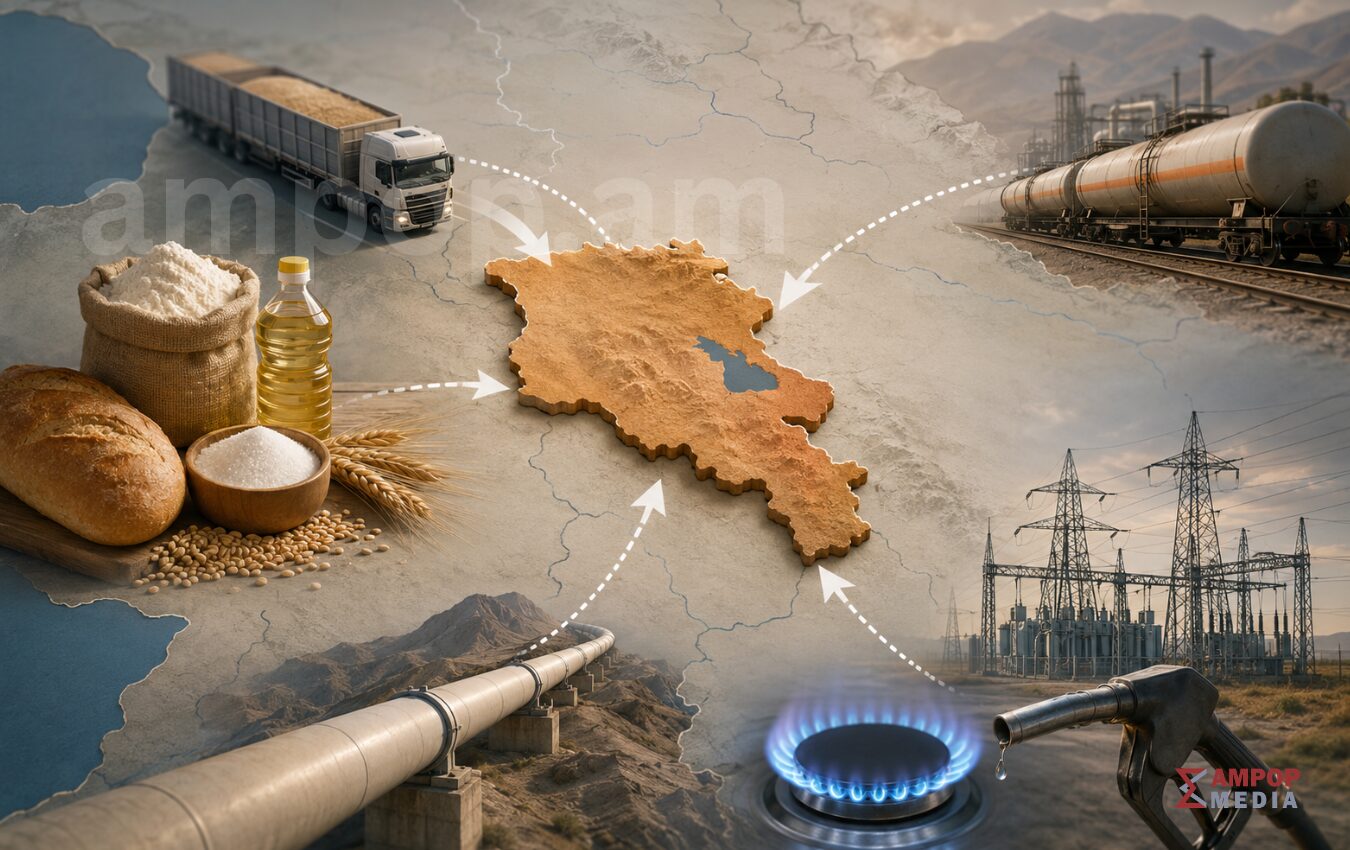
The country’s main vulnerabilities include wheat, vegetable oils, some types of meat, natural gas and petroleum products. In each case, the risk is not simply the volume of imports. It is also the degree to which supplies are concentrated in one country or depend on a limited number of transport routes.
Wheat Is One of the Weakest Links in Armenia’s Food System
Wheat offers one of the clearest examples of Armenia’s dependence on imports.
According to the Statistical Committee’s Food Balance of the Republic of Armenia 2024, the country’s wheat self-sufficiency rate was about 23% in 2024. In other words, imports still cover most domestic demand.
Armenia’s dependence on imported wheat increased further after the 2020 war and the loss of agricultural land in Nagorno-Karabakh. The available data show that Russia now accounts for nearly all of Armenia’s wheat imports.
That leaves the market exposed not only to price fluctuations, but also to political and logistical disruption.
Imports are only part of the problem.
Armenia has about 440,000 hectares of arable land, yet more than half is not cultivated. Of the land that is farmed, only about one-quarter to one-third is used for grain production.
Domestic grain production also struggles to compete with cheaper imported grain and flour.
The combination makes wheat one of the most sensitive components of Armenia’s food security: local production is limited, import dependence is high, and replacing the dominant supplier at short notice would be difficult.
The Risk Goes Beyond Wheat
Armenia is also heavily dependent on imports of several other staple products.
Domestic consumption of vegetable oils is supplied almost entirely by imports, with Russia again accounting for the dominant share. Local production remains very limited.
Sugar presents a different type of dependency. Armenia has some domestic production, but that does not necessarily mean full self-sufficiency.
According to UN Comtrade data, almost all of the country’s imports of raw cane sugar in 2024 came from Brazil. That illustrates a broader point: what is classified as “local production” may itself rely heavily on imported raw materials.
Armenia’s poultry self-sufficiency rate stands at about 25%-26%. Although domestic production has increased, locally produced poultry remains relatively expensive, in part because producers rely on imported feed, particularly corn and soy.
Poultry is also a comparatively affordable source of protein with steady demand, which helps imported products remain competitive.
Self-sufficiency in pork is about 50%, while the figure for beef is close to 90%. Fish is one of the few categories in which domestic production exceeds internal demand: Armenia’s fish self-sufficiency rate reached 118.8% in 2024.
The figures show why food security cannot be assessed through a single national indicator. Vulnerability varies significantly from one product group to another.
Dependence on a Single Supplier Adds Risk
Imports are a normal feature of small economies, and full self-sufficiency is neither realistic nor economically efficient for every product.
The risk increases when imports are concentrated in one supplier or depend on only a handful of transport corridors.
For food products, the main vulnerabilities include supplier concentration, swings in global prices, weather-related disruption and logistics bottlenecks.
Recurring problems at the Upper Lars border crossing, for example, can affect Armenian trade with Russia. Potential restrictions on routes through Iran could create similar pressure on supply and prices.
The UN Food and Agriculture Organization has noted that Armenia continues to import large volumes of wheat even in relatively good harvest years, underscoring the country’s persistent reliance on external suppliers.
The government, meanwhile, has identified food security as a priority, focusing on self-sufficiency, strategic reserves and greater resilience.
There are two distinct policy goals.
The first is full self-sufficiency — an objective that is unrealistic for many products.
The second is reducing vulnerability through a broader supplier base, alternative routes, adequate reserves and better management of domestic production.
For Armenia, the second approach is the more achievable one.
Dependence on external markets is also visible on the export side.
Restrictions imposed recently on some Armenian goods entering the Russian market have been discussed at the highest political level. According to Armenpress, Prime Minister Nikol Pashinyan raised the issue in a phone call with Russian President Vladimir Putin, saying such restrictions ran counter to the Armenia-Russia legal framework and Eurasian Economic Union rules and calling for steps to resolve the problem.
Energy Dependence: Natural Gas Remains the Main Vulnerability
Armenia’s energy dependence carries even greater strategic weight.
The country has no significant domestic industrial reserves of either natural gas or oil, leaving it heavily reliant on imported fuels.
Natural gas is a central component of Armenia’s energy system.
According to International Energy Agency estimates and official data, Armenia imports about 2.7 billion cubic meters of natural gas a year. Roughly 80%-85% comes from Russia, with the remainder supplied by Iran under a gas-for-electricity swap arrangement.
Gas accounts for about 40% of electricity generation and also plays a major role in household heating.
That means a change in gas prices, a disruption in supply or a period of political tension could quickly affect not only the energy system, but also the wider economy and household spending.
Iran could provide Armenia with a degree of diversification.
Territorial Administration and Infrastructure Minister Davit Khudatyan visited Iran on July 25. After returning, he said Tehran needed additional electricity and that the interests of the two countries currently aligned.
“We are successfully implementing the gas-for-electricity program at a certain volume, and it is clear that we have the capacity to do more,” Khudatyan said.
He said expansion would depend both on pipeline capacity and on completion of the 400-kilovolt Armenia-Iran third power transmission line.
“Once the 400-kilovolt line is completed, we will be able to increase electricity supplies and therefore have an opportunity to expand the arrangement,” the minister said.
Russia also remains the dominant supplier of petroleum products, although some diversification has emerged in gasoline imports. Russia’s share of gasoline supplies fell in 2025, while diesel imports remain predominantly Russian.
Solar Power Is Growing — But It Cannot Solve the Whole Problem
Armenia has rapidly expanded solar capacity in recent years.
According to the Ministry of Territorial Administration and Infrastructure, total installed solar capacity exceeded 1,150 megawatts in 2025. Khudatyan announced the figure in a video posted on his Facebook page on March 13, 2026.
The expansion matters because renewable energy can gradually reduce the role of natural gas in electricity generation.
But solar capacity cannot replace gas entirely in the short term, particularly when it comes to heating, dispatchable power generation and balancing the electricity system.
The government’s energy strategy through 2040 calls for a substantial increase in the share of renewables.
Another major long-term decision is the construction of a new nuclear power plant. Extending the operating life of the existing Armenian Nuclear Power Plant until 2036 gives the government more time to make both a technological and political decision on its replacement.
Strengthening Armenia’s energy security will therefore depend on several factors at once: diversifying gas supplies, reshaping the electricity generation mix, deciding the future of nuclear power, integrating more solar energy and expanding regional energy links.
Diversification: What Can Be Done Now — and Later
In food supply, the most realistic short-term step is to diversify import sources.
Kazakhstan, Ukraine and European Union countries are among the possible alternative suppliers of grain and vegetable oils, provided the logistics are workable.
Over the longer term, Armenia will need to increase domestic production, modernize irrigation, expand local feed production and invest in agricultural technology.
But policymakers also need to recognize the limits of self-sufficiency.
In products such as sugar, oilseed crops and some seafood categories, Armenia faces climatic, natural and economic constraints that make substantially higher self-sufficiency difficult.
In energy, sharply reducing dependence on imported gas and petroleum products will also be difficult in the short term. It would require investment, new infrastructure, regional cooperation and technological modernization.
Over a longer horizon, renewables, new nuclear capacity and additional gas or electricity connections could reshape the country’s energy balance.
New Routes Could Begin to Change the Supply Map
There have already been signs of change in Armenia’s logistics network.
During the first months of 2026, more than 24,000 tons of Russian grain were transported to Armenia in transit through Azerbaijan.
Separately, from December 2025 to mid-April 2026, Armenia imported about 9,300 tons of gasoline and diesel fuel from Azerbaijan.
The volumes are still too small to suggest a fundamental shift in Armenia’s supply structure. The country’s main dependencies remain largely intact.
But the flows may represent early signs of new logistics options and limited diversification.
For Armenia, the critical question is therefore not only where a product comes from, but also which route it takes, under what conditions, and how reliable that route would remain during a crisis.
The Bigger Question Is Resilience, Not Self-Sufficiency
Armenia’s food and energy security in the coming years will depend on three broad questions:
- Can the country reduce excessive dependence on one or two suppliers for products and energy sources that directly affect household consumption and living standards?
- Can the government build adequate reserves and rapid-response mechanisms for external shocks?
- Will diversification remain a policy aspiration, or translate into infrastructure, new suppliers, modernized production and stronger regional links?
At this stage, Armenia’s priority is not full self-sufficiency.
It is reducing the areas of greatest vulnerability — particularly where external dependence creates food, energy, economic and political risks at the same time.
Text by Araik Mkrtumyan
Data visualization by Karine Darbinyan
Note: All materials published on Ampop.am and visuals carrying the Ampop Media branding may not be reproduced on other audiovisual platforms without prior agreement with Ampop Media and/or the executive team of Journalists for the Future.
Փորձագետի կարծիք
First Published: 17/08/2026